
Heavy-Duty Rotary Mower Gearbox for Italian Forage Management
Optimized for CE-Compliant Agricultural Operations in European Terrains with 98% Power Transmission Efficiency.
Core Mechanical Advantages and Application Scenarios in Forage Management
The rotary mower gearbox serves as the critical kinetic hub for agricultural slashing, topping, and forage maintenance equipment. Positioned at the center of the mower deck, it receives rotational kinetic energy from the tractor’s Power Take-Off (PTO shaft) and converts it into high-velocity vertical rotation required to drive the heavy blade carriers. When operating in dense vegetation, brush, or uneven pastures, the drivetrain must withstand massive shock loads and continuous multi-directional vibration.
Hengchuang has re-engineered the internal bevel gear configuration to address the specific kinetic demands of heavy-duty rotary cutters. By utilizing drop-forged 20CrMnTi alloy steel subjected to specialized carburizing and quenching processes, our gear sets achieve a surface hardness of 58-62 HRC while maintaining a ductile core. This metallurgical balance effectively absorbs sudden impact forces generated when blades strike hidden rocks or thick tree stumps.

In application scenarios ranging from vineyard floor management in Tuscany to vast pasture clearing in the Po Valley, the equipment demands continuous operation at ambient temperatures frequently exceeding 35°C during summer harvests. The cast iron housing (HT250/QT450-10) features an expanded volumetric oil cavity and optimized structural ribbing, increasing thermal dissipation surface area by 28% compared to standard configurations. This prevents lubricant breakdown and premature bearing failure during extended 12-hour shifts.
For operations focused on highway right-of-way maintenance or commercial land clearing, the mechanical stress profile changes dramatically. The rotational inertia of a 6-foot or 7-foot blade pan generates extreme axial loads. We incorporate heavy-duty tapered roller bearings on both the input shaft and the vertical output shaft to handle these massive thrust forces, ensuring minimal shaft deflection and maintaining precise gear mesh alignment under maximum load conditions.
Gearbox Technical Parameter
Precise engineering specifications are non-negotiable for OEM integration and aftermarket part sourcing. The following parameters detail the operational envelope of our primary rotary mower gearbox series, validated through rigorous dynamometer testing and field deployment.
| Technical Parameter | Specification / Value | Engineering Standard |
|---|---|---|
| Rated Power Capacity | 40 HP to 150 HP (Depending on model) | ASABE S318.18 |
| Nominal Input Speed | 540 RPM or 1000 RPM | ISO 500-1 |
| Input Torque Capacity | 450 Nm to 2,100 Nm | AGMA 6001-F16 |
| Gear Ratio Range | 1:1.47, 1:1.93, 1:1.25 (Speed Increaser) | ISO 6336 |
| Input Shaft Configuration | 1-3/8″ 6-Spline or 21-Spline | DIN 5463 |
| Output Shaft Configuration | 1-1/2″ Tapered Spline or 2″ Tapered 15-Spline | Custom OEM profiles |
| Housing Material | Nodular Cast Iron QT450-10 / HT250 | ASTM A536 |
| Gear Material Metallurgy | Carburized 20CrMnTi Forged Steel | EN 10084 |
| Surface Hardness (Gears) | 58 – 62 HRC | ISO 6508-1 |
| Core Hardness (Gears) | 30 – 45 HRC | ISO 6508-1 |
| Gear Precision Grade | AGMA Class 10 / DIN Quality 7 | AGMA 2015-1-A01 |
| Bearing Type | Heavy-Duty Tapered Roller Bearings | ISO 355 |
| Lubrication Method | Oil Bath Splash Lubrication | Internal flow logic |
| Recommended Oil Viscosity | SAE 85W-140 / EP90 Gear Oil | API GL-5 |
| Oil Capacity | 1.2L to 3.5L (varies by housing geometry) | OEM specifications |
| Oil Seal Material | Double-Lip FKM (Fluoroelastomer) + Dust Shield | ISO 6194-1 |
| Maximum Operating Temp | Continuous: 85°C / Peak: 120°C | Thermal Limits Test |
| Environmental Protection | IP65 equivalent (Dust-tight, splash resistant) | IEC 60529 |
| Fatigue Life (L10h) | > 5,000 Hours under nominal load | ISO 281 |
| Vibration Threshold | < 4.5 mm/s RMS (Unloaded) | ISO 10816-3 |
| Acoustic Emission Level | < 82 dB(A) at 1 meter | ISO 3744 |
| Mounting Bolt Pattern | 4-Bolt Square Base (Commonly 130mm x 130mm) | Industry Interchangeable |
| Mounting Orientation | Vertical Downward Output (Horizontal Input) | Orientation V1 |
| Breather Type | Sintered Bronze Filtered Vent Plug | Standard |
| Surface Coating | Epoxy Primer + Polyurethane Topcoat (75µm) | ISO 12944 C3 |
| Corrosion Resistance | > 500 Hours Salt Spray Test | ASTM B117 |
| Unit Net Weight | 22 Kg to 48 Kg (48 lbs – 105 lbs) | Model dependent |
| Maintenance Interval | First change at 50h, subsequent every 250h | Service Protocol |
Mechanism Positioning and Power Transmission Architecture
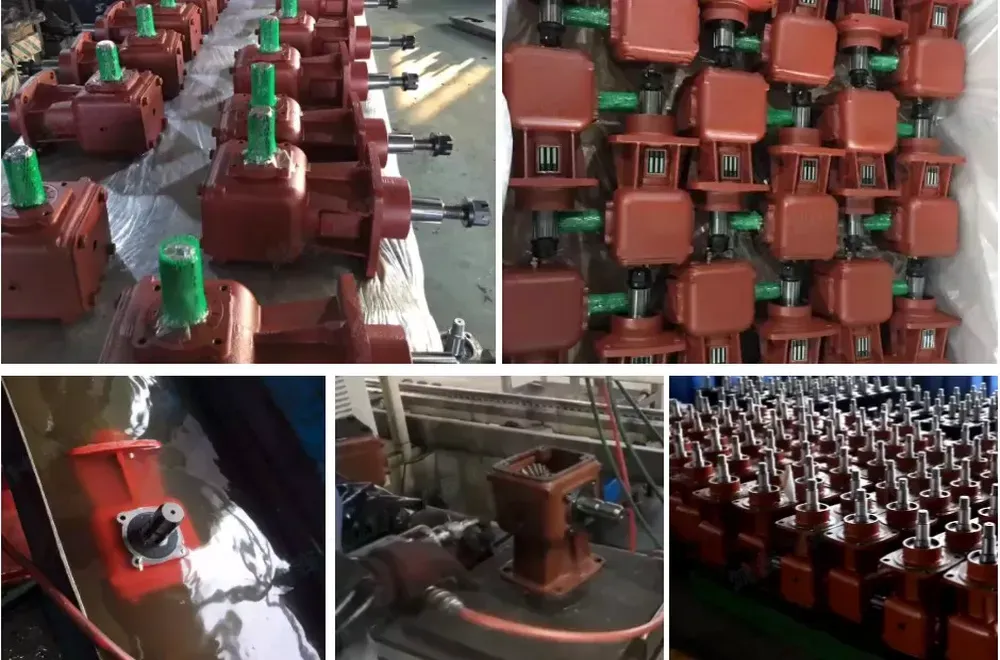
To understand the structural demands on the rotary mower gearbox, one must analyze its positioning within the implement. Bolted squarely in the center of the fabricated steel mower deck, the gearbox bridges the horizontal power delivery from the tractor and the vertical kinetic action required by the cutting blades. The input shaft protrudes forward, engaging the PTO driveline (often protected by a shear bolt or a friction slip clutch) to receive rotational force at either 540 RPM or 1000 RPM.
Internally, the mechanism relies on a 90-degree intersecting axis right-angle bevel gear train. As the horizontal input pinion gear spins, it engages the larger crown wheel mounted on the vertical output shaft. Because the rotary slasher requires high tip speeds to cleanly sever thick forage, the gear ratio is typically an overdrive configuration—for instance, a 1:1.47 ratio steps up a 540 RPM input to approximately 793 RPM at the output stump jumper. This velocity multiplication generates substantial centrifugal forces at the blade tips, often exceeding 15,000 feet per minute.
The lower section of the vertical output shaft features a splined and tapered profile, extending downward through the mower deck. The blade carrier (stump jumper) is pressed onto this taper and secured with a heavily torqued castellated nut and cotter pin. This direct-drive mounting method means every vibration, imbalance, and kinetic shock experienced by the heavy blades is transmitted directly upward into the gearbox lower bearings. To combat this, Hengchuang engineers utilize widely spaced, oversized roller bearings to distribute the radial and axial moments across the robust cast iron housing.

Italy Extreme Operating Conditions Field Study: Terrain & Crop-Specific Gearbox Requirements
Agricultural mechanization in the Mediterranean basin presents unique drivetrain challenges. In Italy, specifically within regions like the Po Valley (Emilia-Romagna and Lombardy) and the rugged terrains of Tuscany and Puglia, rotary mowers face highly polarized operating conditions. During the aggressive management of cover crops in vineyards and olive groves, mowers must pulverize dense, woody prunings (sarmenti) mixed with rocky topsoil.
The impact kinetic energy generated when a heavy steel blade strikes a concealed limestone rock in a Puglian olive grove transfers an immediate shockwave up the vertical shaft. Traditional gearboxes experience gear tooth root fractures or lower seal blowouts under these conditions. Hengchuang addresses this Italian terrain challenge by increasing the gear root fillet radius and specifying double-lip FKM oil seals protected by an external labyrinth steel dust shield. This shield prevents abrasive sandy soils from wearing grooves into the output shaft, a common failure point in southern European agriculture.
Compliance with the European Union’s CE Machinery Directive (2006/42/EC) is strictly enforced across Italy, France, and neighboring states. This directive mandates specific guarding requirements for moving parts. Hengchuang agricultural gearboxes intended for the European market are manufactured with precisely machined mounting bosses to accommodate rigid PTO safety shields. Furthermore, the acoustic emission standards in EU agricultural zones require gear noise levels to remain below 85 dB(A). We achieve < 82 dB(A) through lapped gear sets and strict tolerance control on bearing preloads, ensuring smooth meshing and eliminating the gear whine associated with inferior drives.
Regional tractor interfaces also dictate design. Italian specialized orchard tractors (e.g., Antonio Carraro, Landini, New Holland specialty series) often operate with narrow track widths and variable PTO heights. The input shaft specifications of our gearboxes strictly adhere to ISO 500-1 dimensions, ensuring seamless coupling with standard PTO yoke assemblies without exceeding maximum driveline operating angles.

Global Field Diagnostics: Engineer’s Case Files & Client Solutions
Theoretical specifications only prove their worth in the dirt. Below are direct transcriptions from our field engineering logs, detailing how Hengchuang solves critical pain points across diverse international agricultural zones.
Case Study 1: Emilia-Romagna, Italy – Vineyard Pruning Pulverization
Client Pain Point: “We use heavy rotary slashers to mulch thick grapevine prunings. Our local-brand gearboxes were failing every 300 hours; the lower bearings would disintegrate, and the oil would leak onto the blades, killing our operational window during the tight spring season.”
Hengchuang Solution: “Upon inspecting the failed units, we found that pulverized wood fibers were wrapping around the lower shaft, generating extreme friction heat that melted the standard NBR oil seals. We upgraded their fleet to our heavy-duty series featuring a welded anti-wrap guard and FKM seals rated for 200°C. Bearing life increased to over 1,500 hours, virtually eliminating mid-season downtime.”
Case Study 2: Saskatchewan, Canada – Sub-Zero Wheat Stubble Management
Client Pain Point: “When clearing wheat stubble in late autumn, temperatures drop below -15°C. When we engage the PTO, the sudden torque transfer shears the input shaft right at the splines because the cold cast metal turns brittle.”
Hengchuang Solution: “Cold-weather brittleness requires specific metallurgical adjustments. We shifted the input shaft material from standard 40Cr to 42CrMo, tempering it to increase low-temperature impact toughness (Charpy V-notch energy). Coupled with a recommendation for synthetic 75W-90 cold-weather gear oil, winter shaft breakages dropped to zero in the subsequent harvest.”
Case Study 3: Mato Grosso, Brazil – High-Humidity Pasture Clearing
Client Pain Point: “During the rainy season, our mowers tackle thick Brachiaria grass in 95% humidity. Water ingresses into the gearboxes through the top breather valves as the unit cools down after operation, emulsifying the oil into a milky sludge.”
Hengchuang Solution: “Thermal cycling draws humid air into standard vents. We retrofitted their units with a specialized spring-loaded, one-way pressure relief valve instead of an open sintered vent. This maintained a slight internal positive pressure and physically blocked water ingress during the cool-down vacuum phase. Oil samples taken after 500 hours showed less than 0.1% water content.”
Case Study 4: Queensland, Australia – Extreme Heat and Dust Mitigation
Client Pain Point: “Slashing dry paddocks in 40°C ambient heat creates localized dust storms. The gearboxes run incredibly hot, and the fine red dust acts like a grinding paste on the input bearings.”
Hengchuang Solution: “To tackle the high ambient heat, we increased the external housing ribbing geometry by 30% to maximize air cooling. For the dust, we implemented a triple-lip seal system packed with high-temperature marine grease in the outer cavity. The surface operating temperatures stabilized at 78°C, and bearing contamination was completely halted.”
Case Study 5: Texas, USA – Highway Right-of-Way Contract Mowing
Client Pain Point: “Our contractors run 15-foot batwing mowers 10 hours a day. The center divider gearboxes keep blowing gears due to the massive continuous load pushing multiple decks.”
Hengchuang Solution: “Commercial multi-spindle operations exceed the thermal limits of standard AGMA Class 9 gears. We supplied divider boxes featuring AGMA Class 11 precision-ground helical-bevel gears, increasing the tooth contact ratio. This load-sharing upgrade increased power transmission efficiency to 98.5% and completely eliminated the mid-season gear spalling issues.”

Competitor Comparison and Structural Superiority
When upgrading a drivetrain, empirical data dictates the purchasing decision. The market is flooded with lower-tier cast-aluminum or thin-wall cast-iron alternatives that prioritize upfront cost over lifecycle value. Hengchuang builds solely for the heavy-duty sector.
Compared to standard OEM units (e.g., standard Comer L-25 or Omni RC series equivalents), our upgraded series features a 15% thicker casting wall near the bearing races. Under dynamometer testing, standard 4mm walls exhibit 0.08mm of deflection under a 1500 Nm shock load. Our 6.5mm reinforced walls reduce this deflection to 0.02mm, ensuring the gear mesh remains perfectly aligned. Misaligned gears under shock loads are the primary cause of tooth fracture.
Aftermarket Replacement Indicators: When to Overhaul
Operating a compromised gearbox risks catastrophic failure, which can launch metal shrapnel through the mower deck. Maintenance technicians and farm operators should monitor the following critical failure indicators:
- Excessive Backlash: If the output shaft can be rotated more than 5 degrees by hand before engaging the input shaft, the gear teeth are severely worn or the retaining nut has backed off.
- Acoustic Anomalies: A distinct ‘howling’ noise under load indicates worn bearing races or improper gear mesh due to bearing degradation. A rhythmic ‘clunking’ suggests a broken gear tooth.
- Thermal Overload: If the gearbox housing reaches temperatures where you cannot hold your hand on it for more than 3 seconds (approx. 90°C+), internal friction is abnormal. Check oil levels or bearing preload.
- Radial Shaft Play: Lateral movement in the output shaft indicates complete lower bearing failure. Continued operation will quickly destroy the lower oil seal and gear set.
- Persistent Lubricant Purge: Oil weeping from the input or output shaft seals indicates seal lip hardening or a groove worn into the shaft itself.

Industry News and European Agricultural Mechanization Trends
Recent updates to the EU Common Agricultural Policy (CAP) have introduced stricter eco-schemes, heavily subsidizing mechanical weed control over chemical herbicides in countries like Italy and France. This policy shift is driving an unprecedented demand for heavy-duty rotary cutters and flail mowers for vineyard and orchard under-vine management.
Consequently, farm managers are upgrading their existing 50 HP implement fleets to 80-100 HP systems to increase field speed and cover larger areas. This necessitates aftermarket gearbox upgrades, as the original light-duty 40 HP gearboxes cannot handle the increased torque from larger tractors. Hengchuang is actively supplying European distributors with high-capacity 120 HP rated gearboxes featuring identical bolt patterns to older 40 HP models, allowing for seamless implement repowering.
Frequently Asked Questions Regarding Rotary Mower Transmissions
What is the primary difference between a 540 RPM and a 1000 RPM gearbox?
The input speed dictates the internal gear ratio required to achieve the optimal blade tip speed. A 540 RPM gearbox typically uses an overdrive ratio (e.g., 1:1.47) to speed up the blades. A 1000 RPM gearbox often uses a reduction ratio (e.g., 1:0.8) to slow down the input speed, as 1000 RPM directly at the blades would cause severe imbalance and aerodynamic drag. You must match the gearbox to your tractor’s specific PTO output speed; mismatching them will lead to dangerous blade speeds or ineffective cutting.
Why does my gearbox keep blowing oil out of the top breather vent?
Oil purging from the breather is almost always caused by thermal expansion due to overfilling or extreme overheating. Check your oil level; the oil should only cover the bottom third to half of the lower gear (splash lubrication). Overfilling leaves no air gap for heat expansion, forcing fluid out the vent. If the level is correct, check for wrapped twine or wire on the lower shaft, which causes immense friction and boils the oil.
Can I use standard 80W-90 automotive gear oil in this agricultural gearbox?
While 80W-90 GL-5 is a common baseline, we heavily recommend SAE 85W-140 or a specialized EP90 (Extreme Pressure) gear oil for rotary mowers. Automotive differentials experience steady loads; mower gearboxes experience violent shock loads. The higher viscosity index and extreme pressure sulfur/phosphorus additives in 85W-140 provide a much thicker oil film cushion between the gear teeth during a rock strike, preventing metal-to-metal spalling.
How do I correctly set the slip clutch on the PTO shaft connecting to the gearbox?
A seized slip clutch completely nullifies gearbox protection. At the start of every season, loosen the tension bolts on the clutch, engage the PTO briefly to intentionally slip and polish the friction plates (removing rust), and then re-tighten the springs to the exact compression length specified in the PTO manual (usually around 32-34mm spring height). This ensures it slips precisely at the maximum torque threshold of the gearbox input shaft.
What is the procedure for replacing the lower output shaft oil seal?
Drain the gear oil first. Remove the stump jumper blade carrier using a hydraulic puller (do not hammer it off, as this damages the internal bearings). Remove the protective dust shield. Using a seal puller, carefully pry the old seal out without scratching the cast iron bore. Clean the shaft thoroughly, inspecting for deep wear grooves. If a groove exists, install a speedy-sleeve. Press the new FKM seal in squarely using a seal driver, ensuring the primary lip faces inward towards the oil cavity.

Are Hengchuang gearboxes compatible with Comer Industries bolt patterns?
Yes. Our engineering department meticulously designs our aftermarket replacement housings to match the exact 4-bolt standard metric patterns (e.g., 130mm x 130mm or 140mm x 160mm) used by major European OEMs like Comer and Bondioli & Pavesi. You can unbolt a failed OEM unit and drop ours directly onto the mower deck without any drilling or welding modifications.
What causes the input shaft splines to wear down prematurely?
Spline wear, often called ‘fretting corrosion,’ is caused by a loose connection between the PTO female yoke and the gearbox input male shaft. If the locking pin or clamp bolt on the PTO yoke is not fully secured, the micro-vibrations slowly grind away the splines. Always ensure the yoke clamp bolt is torqued correctly, and apply a high-moly grease to the splines before coupling.
How do I determine the correct gear ratio when ordering a replacement?
If the data plate is unreadable, you must count the teeth. Drain the unit and open the top access plate. Count the exact number of teeth on the input pinion gear, and the exact number of teeth on the larger vertical output gear. Divide the output teeth by the input teeth (e.g., 22 teeth output / 15 teeth input = 1.46). This gives you your 1:1.46 ratio. Provide these tooth counts to our engineering team, and we will match the exact specification.
Comprehensive Drivetrain Ecosystem: One-Stop Sourcing
A gearbox cannot operate in isolation. The synergy of the entire mechanical drivetrain dictates the implement’s reliability. We provide OEM builders and heavy-duty repair facilities with a complete, integrated drivetrain ecosystem, ensuring perfect metallurgical and geometric compatibility across all moving parts.
- Agricultural PTO Shafts: Ranging from series 1 to series 8, equipped with CE-certified wide-angle joints (CV joints), heavy-duty plastic safety shields, and various torque limiters (shear bolt, friction slip clutch, or overrunning clutches).
- Agricultural Chains and Sprockets: High-tensile roller chains engineered for combine harvesters and round balers, featuring shot-peened plates for enhanced fatigue resistance.
- Hydraulic Cylinders: Double-acting welded cylinders for folding batwing mowers and implement height adjustment, featuring chrome-plated rods and advanced wiper seals for dusty environments.

Heavy-Duty PTO Shafts

Precision Roller Chains

Heavy-Duty Hydraulic Cylinders
Manufacturing Excellence: Why Choose Hengchuang
Taizhou Hengchuang Transmission Machinery Co., Ltd. (A member of EVER-POWER GROUP) was founded in 2011. This company, situated in the Economic Development Zone of Luqiao, Taizhou City, has 120 employees, occupies a land of 5,000㎡, and produces an annual output worth RMB 70-80 million. This company is devoted to R&D and manufacturing as well as on various agricultural gearboxes and PTO shafts, and engineering machinery, including: rotary cutter gearboxes, rotary tiller gearboxes, feed mixer gearboxes, rotary mower gearboxes, fertilizer spreader gearboxes, flail mower gearboxes, post hole digger gearboxes, round baler gearboxes, square baler gearboxes, disc mower gearboxes, center pivot irrigation gearboxes, hydraulic drive gearboxes, silage machine gearboxes, orchard sprayer gearboxes, rotary rake gearboxes, combine harvester gearboxes, grain storage gearboxes, grain transportation gearboxes, corn headers gearboxes, cutting bar gearboxes, poultry feeding gearboxes, etc.
Its line of products also includes a variety of high-pressure valve bodies and cast housings. Its products are used in a variety of applications, like farm mower, snow sweeper, fertilizer applicator, grain conveyor, rotary tiller, rotary mower, post hole digger, round baler, with more than 95% of the products being exported to Europe, the United States, Australia, Asia, and Canada, etc. The company has strong technical and R&D capabilities, produces reliable and quality products, practices an excellent operation philosophy, and enjoys a high reputation in the manufacturing community. We maintain stringent ISO 9001:2015 quality control protocols, utilizing Zeiss Coordinate Measuring Machines (CMM) and dynamic gear testing rigs to ensure every unit leaving our facility meets strict CE and AGMA standards. Partnering with Hengchuang guarantees reduced field failures, streamlined supply chains, and superior engineering support.
Secure Your Drivetrain Upgrade Today
Access our complete library of technical drawings, CAD files, and bulk pricing matrices for standard and OEM-customized rotary mower gearboxes. Contact our engineering desk to verify exact fitment and gear ratio requirements.
 English
 Aragonese
 Amharic
 German
 Spanish
 French
 Javanese
 Chinese
 Vietnamese
 Catalan
 Japanese
 Korean
 Kannada
 Italian
 Assamese
 Thai
 Urdu
 Swahili
 Rohingya
 Estonian
 Mongolian